HttpClient and HttpClientFactory in ASP.NET Core

Use the new HttpClientFactory to create HttpClient objects in ASP.NET Core. Learn how to create Named or Typed HttpClient instances.

With .NET Core 2.1 the HttpClientFactory is introduced. The HttpClientFactory is a factory class which helps with managing HttpClient instances. Managing your own HttpClient correctly was not so easy. The HttpClientFactory gives you a number of options for easy management of your HttpClient instances. In this post I’ll explain how to use the HttpClientFactory in your ASP.NET Core application.

Continue reading “HttpClient and HttpClientFactory in ASP.NET Core”

Azure Key Vault recover keys, secrets and certificates

Enable Soft-delete for Key Vault to be able to recover from disaster, recover keys, secrets, certificates or the whole Key Vault on accedental deletion.

Dca4x9OXUAADmh8Last week we had an incident in which we had deleted the wrong secret from our Azure Key Vault. After some research we found that it could have been recovered if we had used the Soft-delete in Key Vault. However, we did not know about this option and could not recover the item.

Continue reading “Azure Key Vault recover keys, secrets and certificates”

Injecting a Scoped Service into IHostedService in .NET 6/7

In .NET 6 and 7, background services (IHostedService) are often used for tasks like long-running processes. These services run in the background and might need to access scoped services (e.g., DbContext). Directly injecting a scoped service into IHostedService causes issues because they have different lifetimes.

To solve this, we can use IServiceScopeFactory to create a scope for each background task. This allows us to resolve the scoped service properly within the background service, ensuring it’s disposed correctly.

Here’s an updated example of how to implement this in a modern .NET application:

Continue reading “Injecting a Scoped Service into IHostedService in .NET 6/7”

Access XML SOAP services in .NET Core and client certificates (SSL)

WCF meets .NET Core

Only a few years back Windows Communication Foundation (WCF) was the way to do communication on the Microsoft platform based on SOAP protocol. Now a days new services are mostly build on top of Representational State Transfer (REST) Services. Sometimes you have to access a ‘legacy’ SOAP services for .NET Core. .NET Core has limited WCF support. In this blog post I’ll explain how to consume SOAP services form .NET Core.
Continue reading “Access XML SOAP services in .NET Core and client certificates (SSL)”

Run scheduled background tasks in ASP.NET Core

In the previous blog post called background tasks with ASP.NET Core using the IHostedService Peter described how to use the IHostedInterface for background tasks. In this post, we continue on this subject and add some pointers on how to perform scheduled background tasks.

In many software projects, there are repetitive tasks; some do just repeat every x seconds after the last instance is finished but you might also have to run a task on a schedule like every 10 minutes. When building repeating or scheduled tasks there are many options on how to approach the scheduling and this approach can be influenced by a number of technical choices.

Building the scheduling yourself is an option when you do not want to add extra dependencies to your project, have full control or just want an extra technical challenge. An out of the box solution you can a look at Hangfire, Quartz.net, or an external service that does an http call every x seconds to trigger the task (something like Pingdom).

Continue reading “Run scheduled background tasks in ASP.NET Core”

ASP.NET Core background processing with IHostedService

Run background processes with the IHostedService and how to inject your services with dependency injection

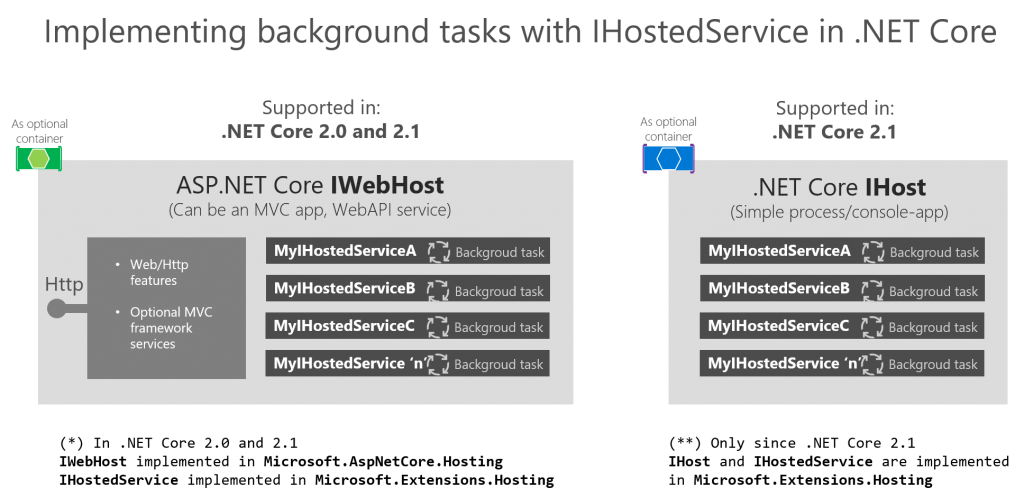
Many services need background processing. The ASP.NET Core 2.X IHostedService interface gives you an easy implementation skeleton to implement background processes. The Hosted Services are registered in the dependency injection at startup and started automatically. You do not have to do the pluming to get them started at startup. On shutdown you can implement a graceful shutdown. When running background processes there a few pitfalls to avoid. In this blog I’ll introduce the IHostedService and how to avoid common memory leaks when implementing the hosted service.
Continue reading “ASP.NET Core background processing with IHostedService”

Cannot access a disposed object in ASP.NET Core when injecting DbContext

The “Cannot access a disposed object” exception in ASP.NET Core, especially when using Entity Framework’s DbContext, is a common issue developers face. This article explores the root causes, prevention strategies, and best practices to avoid this error in modern ASP.NET Core applications.

Understanding the Error

The ObjectDisposedException typically occurs when an attempt is made to use an object that has already been disposed. In the context of ASP.NET Core and Entity Framework, this often involves the DbContext. The error message generally looks like this:

System.ObjectDisposedException: Cannot access a disposed object.

Continue reading “Cannot access a disposed object in ASP.NET Core when injecting DbContext”

Add Index with Include Entity Framework Core

This post explaines how to add index to EF Core with extra columns included from code.

When creating indexes with code first migrations in Entity Framework Core you can create an index on a table by adding the following to your DbContext:

protected override void OnModelCreating(ModelBuilder modelBuilder)
{
    base.OnModelCreating(modelBuilder);

    modelBuilder.Entity<table>() 
        .HasIndex(t =&gt; new { t.Column1, t.Column2}); } 

Continue reading “Add Index with Include Entity Framework Core”

ASP.NET Core correct usage of ConfigureAwait with async/await

Lately we had a discussion on when to use ConfigureAwait(true) or ConfigureAwait(false) in ASP.NET Core 2. In the end most of the team, including me, had a faulty assumption on how to do this in ASP.NET Core. In this case ASP.NET Core is different from ASP.NET. Good to know if you have to decide on what to use in ASP.NET core.

Continue reading “ASP.NET Core correct usage of ConfigureAwait with async/await”

Implement Pessimistic Concurrency in Entity Framework Core

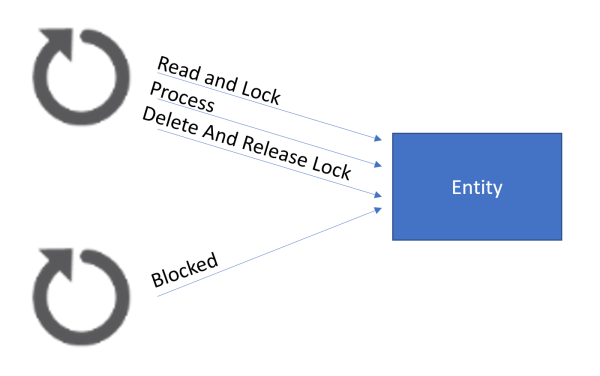
ConcurrencyIn a scenario where we were using SQL server as a queue, before publishing events to external queues, we wanted the data to be processed only once and in order, even with multiple processors for failover. When reading from the table we wanted to lock the records and block other processors from reading those records, while being processed. This is called Pessimistic Concurrency, unfortunately Entity Framework Core does not support this out of the box. To realize Pessimistic Concurrency you need to write your own SQL queries directly on the database (The solution is database type bound, in this case Microsoft SQL server). This blog post will show how it can be accomplished.
Continue reading “Implement Pessimistic Concurrency in Entity Framework Core”